

The Coachella Valley Pats Far More for City Management than Comparable California Cities
 The Coachella Valley functions as a single community in almost every practical sense.
We share a workforce, a tourism economy, infrastructure, and a regional identity. Visitors don’t differentiate between Palm Desert, Indio, or La Quinta—they’re coming to “Palm Springs.” Businesses market to the valley as a whole.
But when it comes to governance, we operate as nine separate cities.
That raises a simple question: what does that structure cost us?
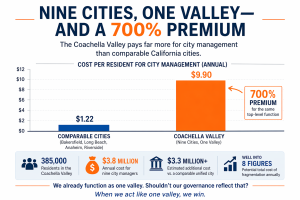
According to 2024 compensation data from Transparent California, the nine cities serving roughly 385,000 residents collectively spend about $3.8 million annually on nine city managers.
Now compare that to similarly sized California cities like Bakersfield, Long Beach, Anaheim, and Riverside. Each operates as a unified city with one city manager overseeing a population comparable to the entire valley.
The average compensation for those city managers is about $462,873.
At a high level, that suggests the Coachella Valley is spending more than $3.3 million above what a comparable unified city would spend on executive leadership alone.
Per resident, the difference is even more striking. Those cities spend about $1.22 per person annually for city management. The Coachella Valley spends approximately $9.90—a roughly 700% premium.
This isn’t about individuals. Most city managers are experienced professionals doing exactly what they were hired to do. The issue is structural.
And the structure doesn’t just stop at city managers. Each city requires its own layers of administration—legal, finance, HR, planning, communications. If even part of those costs scale similarly, the total premium for fragmentation likely reaches well into eight figures annually.
Yet we already have proof, right here in the valley, that regional collaboration can work.
The Coachella Valley Association of Governments (CVAG) and Visit Greater Palm Springs operate under Joint Powers Authority structures. Both are regionally funded, professionally managed, and insulated from the year-to-year political shifts that often affect individual cities.
Both organizations have delivered measurable results. Both have leadership stability, with CEOs serving for more than a decade. And both demonstrate that when the valley acts as one, it can execute at a high level.
That raises an important question: if regional governance works for transportation, planning, and tourism, where else might it work?
It’s also worth noting that population growth doesn’t fully justify the current model. Since 2010, the valley has grown by about 11.2%, with several cities experiencing minimal expansion. This is not a region under explosive pressure—it’s a mature region operating within a legacy structure.
If unified, the Coachella Valley would rank among the ten largest cities in California. Today, not one of its nine cities exceeds 100,000 residents—a scale often associated with greater efficiency and influence.
None of this suggests consolidation would be easy. Local identity matters. Representation matters. History matters.
But so does efficiency—and so does effectiveness.
We already know the valley can collaborate successfully when it chooses to.
The question is whether we’re willing to ask where else that success could apply.