Addition of Mental Health Clinician Reflects Broader Evolution in Policing
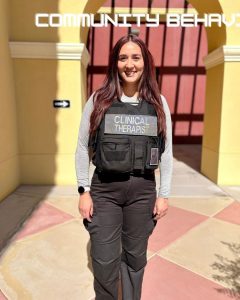
Anna Silva, will serve as CCPD’s full-time Community Behavioral Assessment Team (CBAT) Clinician assigned directly to the Police Department.
CATHEDRAL CITY — The Cathedral City Police Department is among the wave of law enforcement agencies across California and the country is rethinking how they handle mental health-related calls.
The re-evaluation in police departments across the nation — and Coachella Valley — comes in the wake of repeated instances involving the overuse of excessive force and the death of unarmed civilians during the past decade. The demand also grew for communities to reconsider their approach to the personal crises — severe mental illness, homelessness, substance abuse — underlying so many 911 calls, arrests and, sometimes, fatal encounters with police. The debate was supercharged in the summer of 2020, following the murder of George Floyd and mass protests over policing practices, with many activists urging that law enforcement be removed from non-emergency response altogether.
Since then, new programs pairing law enforcement officers with behavioral health clinicians as patrol teams have popped up throughout California, including in Riverside County in 2013, San Mateo County, Pleasanton, Palo Alto, Santa Maria, Sacramento County, Humboldt County and Modesto.
The first Valley law enforcement agency to bring a Clinician Therapist on board was the Indio Police Department in 2019, followed by Thermal and Palm Desert Sheriff’s Department and then Cathedral City and Palm Spring police departments.
These specialized teams respond to mental health related calls that come through the 9-1-1 system, helping alleviate the burden on patrol officers. By working together, the teams are able to spend more time addressing these calls and engaging not only the individuals in crisis but also their families and other impacted individuals. Their primary mission is to divert individuals from unnecessary incarceration, reduce reliance on hospital emergency rooms and connect people to appropriate resources and support services.
The teams help alleviate the burden on regular patrol by responding to complex crisis calls and other mental health related situations. This allows them to spend more time addressing the needs of individuals in crisis, making necessary linkages to community services, and coordinating appropriate care. Their efforts also help reduce the strain on local hospital emergency rooms and decrease unnecessary incarcerations by connecting individuals to more suitable mental health resources.
The addition of a mental health clinician is made possible through a partnership with Riverside University Health System – Behavioral Health called Community Behavioral Health Assessment Team (CBAT). The mental health clinician is an employee,
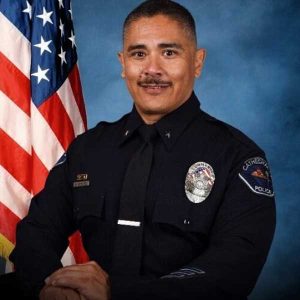
Acting Police Chief Rick Sanchez
“Law enforcement has increasingly become the default responder to complex behavioral health issues, mental illness, substance use, and homelessness-related crises,’ Acting Police Chief Rick Sanchez told Uken Report. “These situations are often not criminal in nature, yet they require time, expertise, and a level of care that goes beyond traditional policing.”
A CBAT program brings the right resource to the right call, Samchez said,
“By pairing a trained behavioral health technician with an officer, we can de-escalate situations more effectively, connect individuals to services, and reduce unnecessary arrests or emergency room visits. Ultimately, it improves outcomes for the individual while allowing officers to remain focused on public safety priorities.”
From a leadership standpoint, Sanchez said the goal is threefold:
- Improve service to the community by ensuring residents experiencing behavioral health crises receive compassionate, appropriate, and timely care.
- Enhance officer effectiveness and safety by providing them with a partner who has specialized training in crisis intervention and behavioral health.
- Strengthen long-term solutions by connecting individuals to resources that reduce repeat calls for service and improve overall community well-being.
“This program is about being more proactive, more humane, and more efficient in how we serve our community,” Sanchez said.
Prior to the CBAT technician position, patrol officers handled these calls largely on their own. While our officers are trained in de-escalation and crisis response, they are not clinicians, Sanchez said. That meant options were often limited, typically involving detention, hospitalization, or temporary resolution without long-term support.
This approach could lead to repeat interactions with the same individuals, increased strain on emergency services, and outcomes that didn’t always address the root cause of the issue, he explained. The addition of a CBAT technician fills that critical gap by providing immediate, on-scene expertise and access to resources that were previously harder to coordinate in real time.
“This program reflects a broader evolution in policing, one that recognizes public safety includes addressing behavioral health challenges with the right tools and partnerships. It’s not about replacing law enforcement; it’s about enhancing it,” Sanchez said.
We’re proud to be part of a collaborative approach that prioritizes dignity, reduces strain on the system, and builds trust within the community, he added. “Programs like CBAT represent the future of public safety, where enforcement, care, and prevention work hand in hand.”
So, is there proof the program is working?
From February 2021 through December 2025, there were 404 requests for CBAT crisis services in partnership with the Indio Police Department. During that time, the CBAT team served 326 individuals experiencing a behavioral health crisis.
Clinicians were able to provide crisis intervention services in approximately 90% of requests (363 incidents). Among those incidents, 37% (134 individuals) were diverted from an inpatient psychiatric admission.
Additionally, 42% of individuals served during this time period were connected to outpatient behavioral health services following contact with the CBAT team.
The Indio program initially launched with a clinician serving in a combined outreach and crisis response role. The model transitioned to a dedicated crisis response partnership with local law enforcement a few months ago as the program has continued to evolve in the Coachella Valley.
According to a study of San Mateo County’s efforts from Stanford’s John W. Gardner Center for Youth and Their Communities, which found that pairing law enforcement officers with mental health clinicians reduces the likelihood of costlier and more intrusive interventions.
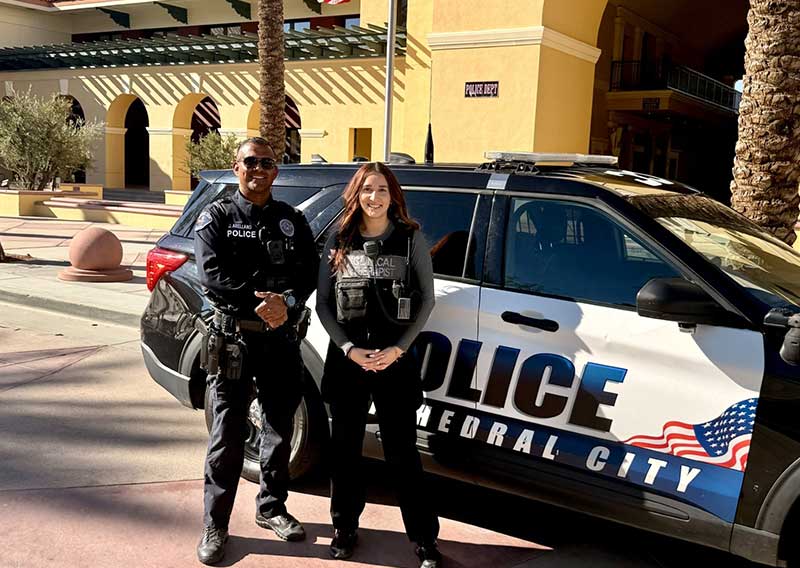
Photo caption above: Anna Silva will be partnered with Officer Jose Arellano as part of CCPD’s specialized co-responder unit. This team pairs a licensed behavioral health clinician with a police officer to respond to:
.
Image Sources
- 2026-CBAT-800×568: CCPD